

Penelope Had No Athena
On the gods who guide us, journeys we recognize, and what remains when no one comes

Hello
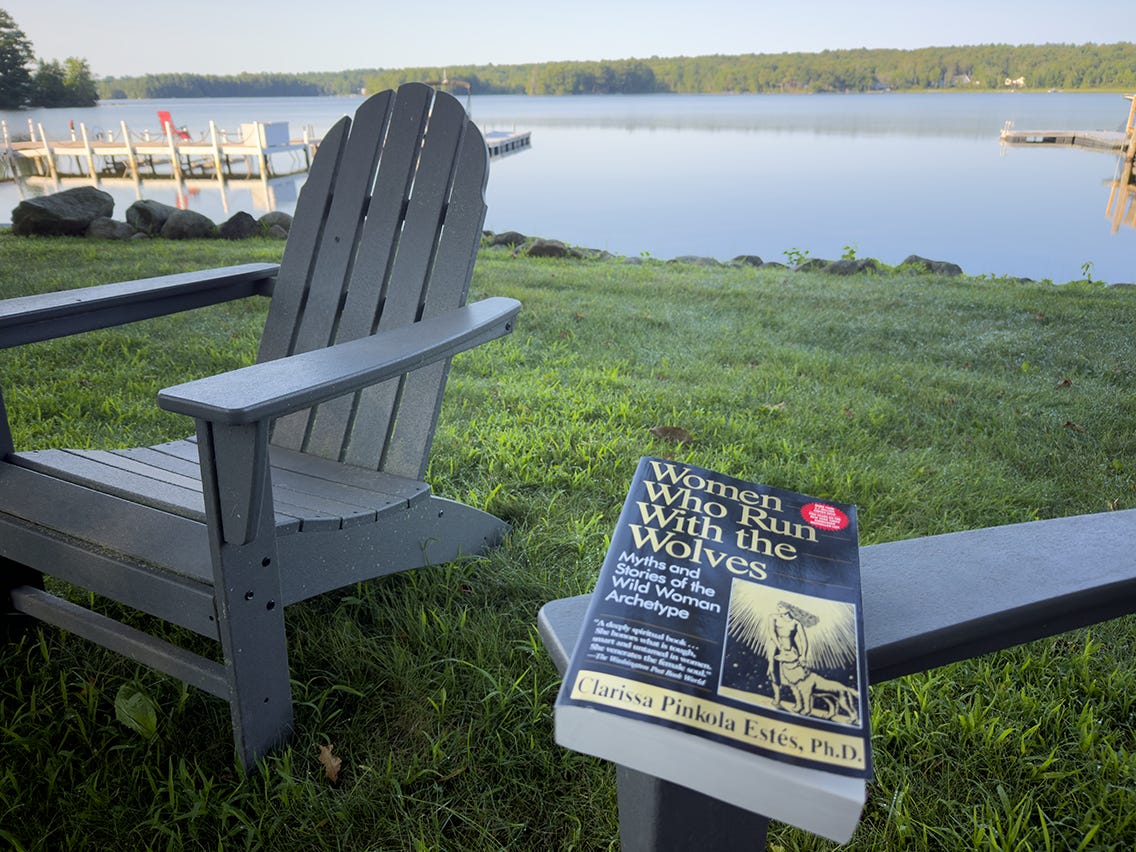
This weekend I gave my daughter Clarissa Pinkola Estés’ Women Who Run With the Wolves.
I wanted her to encounter, earlier than many women do, the idea that there is something within her older than approval. Something instinctual and discerning that she should learn to hear before the world becomes too successful at speaking over it.
Then I found myself thinking about Penelope; probably because I have spent much of my own life admiring Odysseus, and admiration is rarely disinterested.
I understand the seduction of the journey. I have built things, crossed oceans, climbed mountains, and pursued distant things largely because they were distant, which is a motive I would not defend in a boardroom.
Our culture has an elaborate vocabulary for these journeys: adventure, ambition, courage, achievement, quest…and the social media accounts with photographs to prove them.
But reading these old stories again as the father of a young woman, I found myself asking a question I do not remember asking when I was younger.
Why does Odysseus get Athena?
He gets monsters, shipwrecks, seductions, captivity, war, and a journey that takes twenty years to complete. He also gets a goddess. Athena counsels him. She disguises him. She advocates for him among the gods, protects Telemachus, manipulates circumstances in his favor, and helps prepare the conditions for his return.
Penelope gets something different. She gets uncertainty.
That is not literally to say Athena is absent from Penelope’s story. In Homer, Athena does intervene around Penelope, bringing her sleep and appearing to her in dreams. But the relationship is strikingly asymmetrical.
Penelope does not enjoy the sustained, recognizable divine companionship that Odysseus does. For twenty years she does not know whether her husband is alive or dead.
She raises their son, preserves a household under siege, resists more than a hundred suitors consuming its wealth and attempting to appropriate its future, and manages the political consequences of an absent king while living inside unresolved grief.
I wrote earlier this summer about the speech that killed Odysseus’ crew, where a month of disciplined starvation ended inside a day because one brave man made a persuasive argument for the fatal thing.
Penelope absorbs that pressure from more than a hundred men for twenty years and does not break. To do so, she devises one of the great acts of cunning in the poem.
By day, she weaves the burial shroud of Laertes, promising that when it is finished she will choose a husband. By night, she unweaves it. We usually associate mētis, cunning and adaptive intelligence, with Odysseus. Penelope has it, too.
The difference is that Odysseus’ intelligence gets an epic landscape in which to display itself. Penelope’s happens at home.
The journey that does not depart
Joseph Campbell gave us an enduring grammar for the hero’s journey: departure, threshold, ordeal, assistance, transformation, return. It is difficult to imagine a better inhabitant of that architecture than Odysseus.
But Penelope exposes something the architecture can make harder to see. She does not cross the threshold. The threshold comes to her and refuses to leave…for twenty years.
There are no Cyclopes in Ithaca, no Sirens, no descent into Hades. Her trials arrive disguised as repetition: another morning without news, another suitor at the table, another night undoing what she wove by day. Odysseus’s transformation moves across a map. Hers occurs while standing, apparently, in the same place.
None of which is an argument against Campbell. The version of the hero’s journey and the monomyth that got popular is considerably narrower than Campbell’s own understanding of myth; and the narrowing is the interesting part to me.
Our culture kept the visible stages and dropped the rest without noticing it had. We know how to recognize a journey when someone goes somewhere. We are far less practiced at recognizing what happens to the person who stays.
I think that is why Angeles Arrien’s work has stayed with me alongside Campbell’s. She was a cultural anthropologist, and her archetypal vocabulary makes room for forms of development that the traditional heroic journey obscures.
Angeles drew her archetypal frame from cross-cultural material and named it for the figures that carry them in many traditions at once: the Four-fold Way. The archetypal figures in Arrien’s work are defined as the Warrior, who shows up and chooses to be present; the Healer, who pays attention to what has heart and meaning; the Visionary, who tells the truth without blame or judgment; and the Teacher, who stays open to outcome without being attached to outcome.
That last one is the whole of Penelope’s position. Openness to an outcome you cannot force, held without attachment to it, for twenty years.
Not every journey requires departure. Some require remaining fully present to a life whose answer has not yet arrived. That raises a question that reaches well beyond Homer.
What is the mythology for the person whose transformation leaves no GPS track?
Where did God go?
Carl Jung spent much of his life wrestling with a related question. He grew up inside Christianity, the son of a pastor, surrounded by the language and authority of an inherited God, and the God of doctrine became increasingly insufficient for what he believed he had actually experienced.
His development took him through a confrontation with the unconscious, the strange inner figures he later recorded, and toward a radically experiential understanding of religious life.
Late in life, interviewed by John Freeman for the BBC’s Face to Face in 1959, Jung was asked whether he believed in God. His answer has become famous: “I know. I don’t need to believe. I know.”
For Jung, the movement inward did not mean that the ego became God. Individuation gradually confronts the ego with the fact that it is not sovereign. The Self is larger than the conscious personality, and the numinous can arise within the psyche and still be experienced as profoundly other.
Suddenly Athena becomes psychologically interesting, doesn’t she?
Odysseus can see the goddess, hear her counsel, and receive wisdom with a face attached to it. Penelope largely has to act without that reassurance.
I have come to think maturation often involves precisely this transition, from wisdom encountered as an external authority to wisdom that has to be lived without the authority standing beside us. The parent, the church, the teacher, the mentor, the analyst, the institution, the map. At some point, none of them can make the decision for us.
This does not mean Penelope simply becomes Athena. That would make the ego sovereign again. Something subtler happens. She becomes capable of acting from the wisdom Athena represents without possessing Athena.
Jung pushes the relationship further in Answer to Job, where he offers the startling reading that Job’s moral consciousness confronts something insufficiently conscious in Yahweh himself. In Jung’s interpretation, the human encounter with the divine changes not only the human being but the God-image. The relationship is developmental in both directions.
So the disappearance of an external god may open a more demanding relationship with the numinous rather than close the account. This turns the question from why Athena did not help Penelope as she helped Odysseus into something harder:
What happens to us when the god who guided us stops appearing in the form we recognize?
What if no answer comes?
Stoicism offers an important correction here. Jung asks what the absence of Athena means. Stoicism asks what Penelope is obliged to do while that question stays open.
For Epictetus, the fundamental task is to distinguish what is up to us from what is not. Penelope cannot control whether Odysseus lives, when he returns, the ambitions of the suitors, or whether Athena reveals the ending. She can govern her judgments, choices, conduct, attention, timing, and response.
Stoicism does not require a personal Athena. Its providential cosmos makes no promise that events will arrange themselves according to our preferences, because providence is not favoritism.
This makes Penelope’s situation more severe, and a great deal closer to most of ours. No revelation may arrive; no dream may resolve the ambiguity; no mentor may appear at precisely the right moment, and no synchronicity may tell you which door to choose.
Sometimes there is no message to decode before action is required. You still have to choose. You still have to become someone through the choosing.
Marcus Aurelius poses the same either-or, at least seven times across Meditations. Either the universe is governed by something that intends, or it is atoms colliding without design. He never picks, because his point is that the answer changes nothing about what you owe. Jung asks us to stay attentive to meaning. Stoicism refuses to make meaning a prerequisite for character.
Penelope stands somewhere between them. She does not know whether her waiting will be vindicated, whether the gods favor her, or whether Odysseus is coming home. And still she exercises judgment.
There is a term for what she is doing, and I have never been able to unsee it. Odysseus operates a closed loop, with Athena as his feedback signal, telling him what is actually happening so he can correct against it.
Penelope operates within an open loop, with no observability at all. This means she cannot correct against reality, and can only hold her conduct steady while the error accumulates unseen.
When the signal stops, character is the model. So, let’s call that what it is: ethical agency under radical uncertainty.
The journey we do not photograph
There is something here that I suspect men like me have historically been trained not to see very well. We recognize Odyssean difficulty because it looks like difficulty.
There are mountains to climb, businesses to build, enemies to defeat, oceans to cross. Achievement culture is extraordinarily good at measuring outward movement.
Penelope’s ordeal looks dangerously like staying home. But staying is not the same thing as remaining unchanged.
There are people whose great developmental journeys happen while someone else is getting the photographs: the spouse who holds a family together while a partner builds the company; the parent whose ambitions change shape because somebody has to remain; the adult child who becomes the family’s fixed point; the person whose courage consists not in leaving but in enduring ambiguity without surrendering discernment.
Holding something together while someone else gets to have the odyssey.
Homer assigned that position to a woman, and for most of the time since, the assignment held. It has come loose in my lifetime. I know households where the wife travels and the husband is the one keeping the calendar, the friendships, and the emotional weather of the house intact. I know a few where the arrangement has traded places more than once. What has not come loose is the invisibility.
Whoever stands in that position still tends to disappear from the telling, and when it is a man, he often carries the additional problem of having no available script, which can leave his version of the ordeal invisible even to him.
There is a mechanism under that last part that is not metaphorical.
Retrospective duration is built out of event boundaries. When people judge how long a stretch of experience lasted, what predicts their answer is the number of distinct subevents they can recall. A 2026 study in Psychonomic Bulletin and Review found the effect startlingly clean: each additional subevent a participant recalled added roughly twelve seconds to how long an eighty-second clip was judged to have been. What did not predict the judgment was how much detail they remembered about any of it. Only how many boundaries.
Odysseus’s twenty years are almost nothing but boundaries. Cyclops, Circe, the descent, the Sirens, Calypso. Penelope’s twenty years are one room, one loom, and the same men at the same table.
One way to read that is bleak: the missing photographs are the smaller loss. The years themselves encode thinner, and the ordeal can go missing from the archive of the person who actually lived it.
I should be careful here, because this should not become another romantic mythology of feminine sacrifice. Women have been told for centuries that waiting, accommodating, enduring, and disappearing into other people’s stories are virtues.
Sometimes staying is fidelity and sometimes it is fear. Just like sometimes endurance is courage and sometimes it is self-abandonment.
Two weeks ago I wrote about the danger that never forces a decision, the condition where nothing breaks, no emergency arrives, and a person can continue indefinitely without ever being made to ask whether the life still fits. The loom is that condition with a loyalty attached.
Penelope could have woven and unwoven until she died, and from the outside it would have looked identical to what she was actually doing.
Which is which?
That question brings me back to the book I gave my daughter. Pinkola Estés’s wild woman is not simply an enduring woman. She is instinctual, discerning, creative, desirous, and boundary-making. She knows something before she can necessarily explain how she knows it. So Penelope and the wild woman should not be collapsed into one another. They should trouble each other, in fact!
When is waiting fidelity, and when is it self-abandonment?
No goddess can answer that question once and for all. It requires discernment. Hence, I am beginning to think that is precisely the capacity we should be helping our daughters develop.
No one has an odyssey alone
There is another reason Penelope reads differently to me now. I have been allowed an unusually Odyssean life. I use that comparison and word carefully, because what I share with him is the shape and not the stature.
I went toward distant things, some of them improbable, and followed questions well past the boundary of an ordinary map. A great deal of that was circumstance and permission. The portion that was actually merit is smaller than the story makes it look.
The comparison to Odysseus carries something else with it. He arrives home alone. Every man who sailed with him is dead, several of them through his own decisions, and Homer does not soften it.
The Odyssean life is the one that gets the narrative, which is a different thing from being the one worth having. And, no one has an odyssey alone. Some freedoms exist because somebody else holds parts of the world together while you wander past its edges.
My wife has done that for me more times than I was tracking at the time. The word I keep reaching for is willing, and I have learned to distrust it, because willingness is the kind of thing a person in my position checks once and then files as permanently settled.
So I asked her. Again, as it happens. I had asked the same question a little over three years ago, before I left for Everest. Three years is nothing, and I have only recently understood that the two were not the same question.
The first was asking whether I could go. The second was asking what it cost that I did. The distance between them is not measured in time, which is how a conscientious person can ask the first version for decades and never once arrive at the second.
That was my failure, and I suspect it is the common one.
The second conversation is where the practice at the end of this essay came from, and I would not describe it as comfortable.
What came back corrected my accounting in both directions. She chose the arrangement deliberately, with a clearer view of its cost than I had credited her with, which means I had been giving her too much credit for endurance and nowhere near enough for judgment.
The time during which I was away built something between her and our daughter that I am not inside of, and cannot describe from where I stand. It is something that would not exist in the same shape if I had been home for all of it. That is not a consolation I get to award myself. It is a fact about a room I was not in.
I said thank you afterward. I had said it many times before and never once earned it, because I had been thanking her for the wrong thing. She gave me two things for the page and kept the rest.
The first, and I am reconstructing her wording rather than quoting it, is that she did it because she knew it was what my soul demanded. That is the most flattering sentence anyone has ever handed me. Curiously, it is also the one I trust least, because a man in my position should be very slow to accept an account of his own necessity from the person who paid for it.
The second I remember exactly, word for word, because it was the part that landed most definitively inside of me. Her more traditional role in our marriage, she said, was ‘chosen, not assigned.’ Three words that use the instrument this essay has been building toward.
She ran the test on herself and came back with fidelity. That settles one question and leaves the other standing. She chose it, and it still cost what it cost. Reaching for her yes as an answer to the accounting would be the tidiest mistake available to me.
The rest of what she told me is hers. She asked that her own journey stay out of this, which I am honoring. By declining to become material, she exhibited the very discernment this entire essay has been circling.
So I do not call her my Penelope. Reducing her to a supporting character in my journey would reproduce exactly the blindness I am trying to examine.
The first essay I published here argued that you cannot return home as the one who left. That is true, and it is only half of the arithmetic. The home you return to has also been in motion the entire time, and the person who kept it did not spend those years waiting for the plot to resume.
But I can say this: I understand Odysseus differently now because I understand better what his story does not show. The journey of the person who leaves is easier to see. The journey of the person who makes leaving possible can disappear entirely.
Part of growing older, I think, is learning to see the invisible architecture beneath your own accomplishments. Who held something while you climbed, who absorbed uncertainty while you explored possibility, and who made the ordinary continue while you pursued the extraordinary?
Those questions do not diminish the journey. They make its authorship more honest.
Entitled to the whole mythology
All of this brings me back to my daughter.
I thought I was giving her Women Who Run With the Wolves because I wanted her to encounter the wild woman early, to understand that instinct is not something to outgrow, that discernment is different from approval, and that a life can become outwardly successful while becoming inwardly estranged from itself.
But there is something else I want her to inherit, and it took writing this to find it. Not Penelope in place of Odysseus, or staying in place of leaving, or the feminine in place of the masculine.
I want her to know that she is entitled to the whole mythology, and she will edit this list, which is the point: to Athena’s intelligence, to Odysseus’s journey, to Penelope’s discernment; to the Warrior’s presence, the Healer’s attention, the Visionary’s truth, and the Teacher’s willingness to remain open to an outcome she cannot force; to the wildness Pinkola Estés asks women to recover; and eventually, to a life that cannot be reduced to any of them.
She is twenty-one, which puts her inside the stretch of life that autobiographical memory keeps best. The research calls it the reminiscence bump, which happens roughly between the ages eleven to twenty-five. One of the better-supported explanations of the concept is simply that so much of what happens then is happening for the first time. She is laying down the densest record she will ever lay down.
I am at the other end of that curve, where the years have started arriving pre-compressed.
As her father, my task cannot be to become Athena, hovering over her journey, arranging favorable outcomes and whispering the correct move. Nor can I hand her my map. The better hope is that she develops enough trust in her own discernment that she does not spend her life waiting for Athena to appear.
Because sooner or later, for all of us, there comes a moment when no god arrives, no authority can tell us what happens next; and no map contains the territory we have entered. Still, a choice must be made.
Each of these fails where the next one starts
Cognitive neuroscience can tell you why the stayer’s ordeal thins in memory, and it has nothing whatsoever to say about whether she should have stayed.
Homer gives us the images and withholds the interior. We watch Penelope weave and unweave for twenty years and the poem never once tells us what it cost her.
Jung supplies that interior, and then tends to find meaning everywhere, including in places that have none to give.
Stoicism cuts that drift off at the knees by refusing to make meaning a precondition for conduct, and it leaves us with a floor and no ceiling. In other words, with nothing useful to say about why the numinous keeps arriving in people who did not request it.
Estés names what a long male-authored tradition kept filing as domestic scenery: the woman standing still has an instinctual intelligence of her own, and she is not the moral of somebody else’s story. Underneath all of it runs the timeline nobody gets out of.
These are survivable as ideas in the first half of a life. In the second half they arrive as decisions, with deadlines, attached to people who will feel the outcome.
Homer, Jung, Epictetus, and Estés are in the room together for that reason and no other. Aim them at a single problem until they begin correcting each other, because any one of them, held alone, would have let me off the hook.
Run the conditions check
Odysseus was accompanied by the goddess and Penelope was not; Jung spent a lifetime asking where the god had gone, and the Stoics asked what remained ours regardless. My best guess is that adulthood begins somewhere in the space between those answers, at the point where we learn to recognize wisdom after it has stopped arriving in the form we expected.
There is literature on the error this essay has been hinting at, by the way. Aimed at other people it is the fundamental attribution error; aimed at your own accomplishments it is self-serving bias. Either way, we over-credit whoever was visibly acting and under-credit the conditions that made acting possible.
Homer does it to Penelope. Achievement culture does it to whoever is holding the calendar. Most of us do it inside our own households without once intending to.
So run the check. It takes about twenty minutes and one uncomfortable conversation.
Choose an accomplishment you are actually proud of. Not the largest one, the one you would mention.
Write down what had to stay steady for it to happen. Not your effort, the conditions. Who took the call you did not take, who kept the ordinary running at the exact hours you were unavailable, and who absorbed the uncertainty you were then able to convert into a story.
For each name, write what it cost them, in specifics. Hours are specific. So is a career interval, or a decision they did not get to make. “Support” is not.
Then do the part that makes this a protocol rather than a reflection. Within seven days, say one of those costs out loud to the person who paid it. Gratitude is easy to receive and easy to discount, so make it a description instead:
‘Here is what I now think that cost you, and here is what it bought me.’
They will correct your accounting. The correction is the most valuable thing in the exercise, and it is the only part you cannot do alone.
There is a mechanical reason for that, and I ran into it while writing this. I kept three words of what my wife said and rebuilt the sentence around them from nothing. That is precisely what the event-boundary research predicts.
The boundary survives and the detail goes, which means the specifics this exercise asks for are the first thing memory discards, and the other person is still holding them. You are not going to reconstruct them. You have to go and ask.
Then turn it around, because most of us occupy both positions at different times in a life. Where are you currently the one holding something steady while somebody else moves?
Name the test that would tell you whether that is fidelity or self-abandonment. If no test comes to mind, that is the finding.
And if you are willing to write back one line, make it this: what in this essay felt most true, and what felt most incomplete? Replies reach me directly. I read every one, and they shape what I build here next.
A note on the timing. This publication sends on Sundays, and today is a Wednesday. My daughter turned twenty-one this week; one of her gifts was a book, and the essay came out of both.
That makes this the second send in two weeks that the calendar did not choose. I am going to stop calling those exceptions. A weekly schedule is a loop like any other, and the criterion was never the day. It is whether the writing is worth your time when it arrives. Sunday’s essay is unaffected.
Next Sunday: the archetypes. The old patterns that organize a life without asking permission, why understanding yours completely can leave you living it anyway, and the argument between Arrien’s four and the four you have probably already met.
Start here
Every essay in this publication builds on the five that launched it. If you are new, they are the place to begin.
Yet again, a piece that, however much it seems like a personal letter meant for me, I know isn't mine. Still, I lingered to read it, out of curiosity. Maybe because so many people have been discussing The Odyssey on Substack lately. Or maybe it's Penelope herself who captivates me: the solitary strategist, intelligent, composed… the very emblem of loyalty… forced to rely solely on her patience and her wits, with no god to guide her…