The Grief That Doesn't Look Like Grief
On Nims Purja and the mourning that happens with the hands

I publish on Sundays and today is Wednesday. And, I am breaking the schedule on purpose.
Something happened that does not belong to a content calendar, and pretending otherwise would make everything else I write here less true. A publication about closing the gap between knowing and living cannot keep its composure on schedule while its author loses his.
So this arrives out of order, because the week did.
Nirmal Purja died on Broad Peak last week. Most people knew him as Nims, the man who climbed all fourteen eight-thousanders, the peaks above eight thousand meters, in six months, when the record books said the project needed years, the man who made the impossible look like a logistics problem that simply had not met the right planner yet.
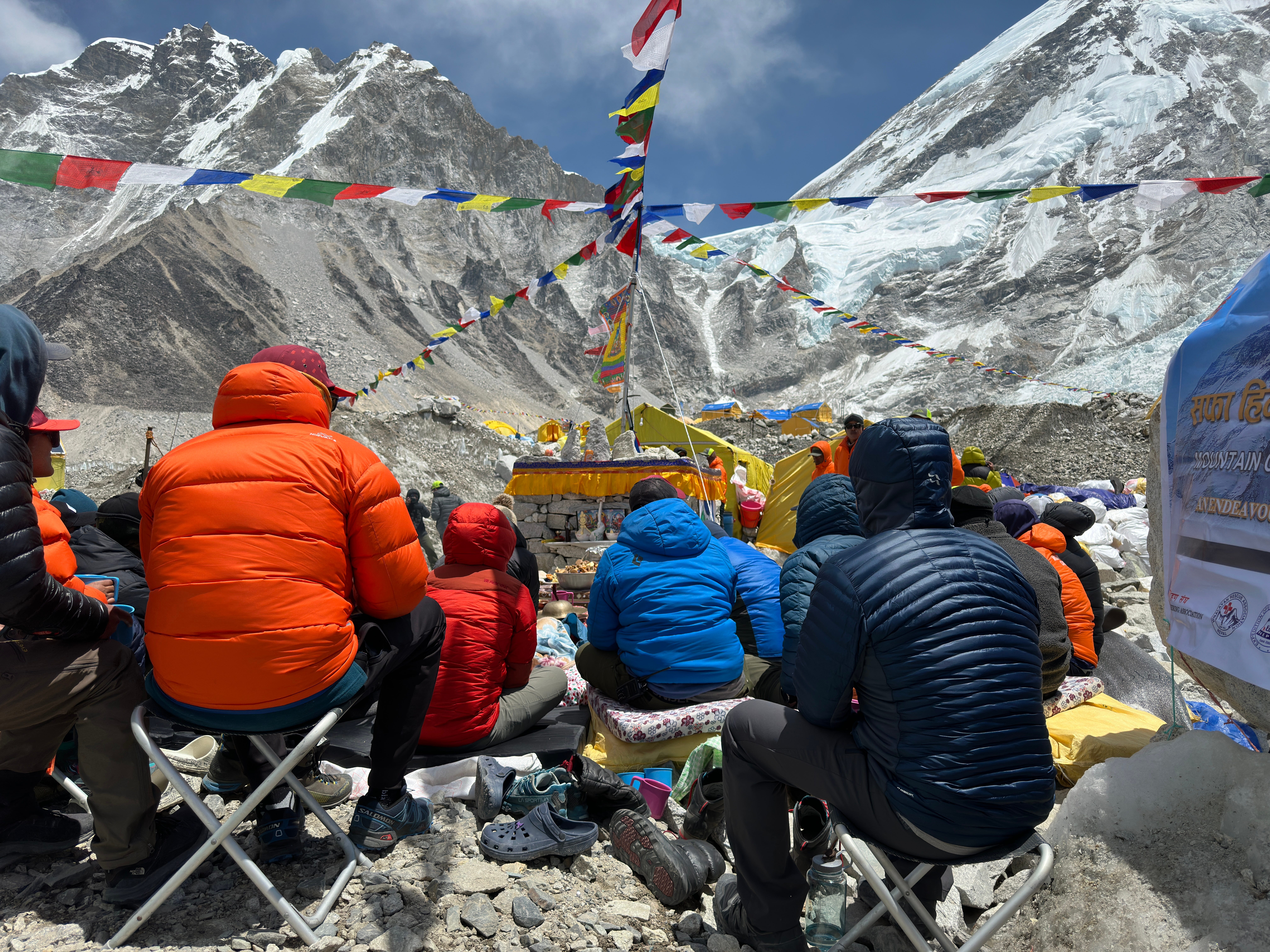
I had the privilege of meeting him during my Everest expedition. Heroes usually shrink at close range. The persona that photographs well turns out to be load-bearing, and up close you can see the scaffolding.
Nims did not shrink. He was generous with his time when he had none to spare. He asked questions and stayed for the answers. He talked about his team the way other men talk about their own ambitions, and he meant it, because a mountain leaves nowhere to hide the difference. Whatever he was on camera, he was more of it in person. That is rarer than any record he set.
The first reports reached me last Thursday: an avalanche on Broad Peak, climbers missing, Nims among them. For two days I refreshed my phone, hoping the next update would bring a miracle. He had walked out of situations that should have ended him; it did not seem unreasonable to expect one more.
On Saturday the confirmation of his death came instead. I posted a short note, closed the app, and returned to my day, because that is what the day appeared to require. It is Wednesday now, and in the four days since, I have discovered I had not finished.
The loss kept surfacing at hours it had not been scheduled for, in the middle of work that had nothing to do with mountains.
Grief does not respect the length of a note. It was not done with me just because I had found words brief enough to post. Part of what the loss had to work with was memory.
I was on the summit of Everest in 2024 when two climbers plunged to their deaths a few feet in front of me: Daniel Paterson of Britain and Pas Tenji Sherpa of Nepal, twenty-three years old, climber and sherpa taken together, on the descent from a summit they had just reached. A few feet. Nothing about that margin was earned. It was placement on a line, the mountain choosing without malice and without reason.
In those same days Gabriel Tabără of Romania, attempting Lhotse without bottled oxygen, died in his tent at Camp 3, at night, quietly, with a whole camp asleep around him.
Three deaths, two violent and witnessed, one silent and discovered, all on the same species of mountain that took Nims. Their names belong in this essay as much as his does.
So when the reports came in from Broad Peak, my body already knew what the words meant. This was not news arriving from a world I visit through a screen. I have stood inside that kind of death, close enough to be included in it, and came home anyway.
Nims’s death did not only take a man I admired. It reopened the question every survivor of the eight-thousanders carries and mostly keeps sealed: why them, why him, and not me.
Here is what I want to say about that, and it is the reason this essay exists rather than staying in my journal:
I hold a doctorate in psychology. I have sat with executives through the deaths of partners and parents. I teach that the body registers what the mind negotiates around.
And when this loss arrived, my first reflex was the same one I have watched in a hundred accomplished men: compose the face, organize the feeling into a paragraph, return to work.
Notice what that reflex actually is, though. It is competence, redeployed as anesthesia. The same capacity that runs a company or leads a rope team turns inward and starts managing the griever instead of the grief.
Development does not exempt you. Training does not exempt you. If anything, expertise supplies better language for the avoidance, which makes the avoidance harder to catch.
The reflex is older than anything I learned, and it runs on rails laid down long before any of us chose our beliefs about what men are permitted to feel. And the rails are maintained daily: every time composure gets rewarded, and in the rooms where I work it is rewarded constantly, the loop tightens.
A man can reach late midlife with a reflex so well reinforced that he mistakes it for his personality.
Grief research has a name for part of this. Kenneth Doka and Terry Martin describe what they call the instrumental style of grieving: mourning that moves through action, problem-solving, doing something with the hands, rather than through telling.
It is a continuum rather than a category, and it is not owned by men, though the socialization that installs it mostly is. It is a real way of mourning.
The danger is in the misreading, by others and by the griever himself. A man who believes his grief must look like talking, and who cannot talk, concludes he has no grief, and the loss goes underground to do its work unsupervised.
Unsupervised grief does not idle. It resurfaces wearing other clothes: irritability, flatness, a shortened horizon, a sudden allergy to things that used to matter. The mourning happens either way. The only question is whether you are present for it.
There is a second trap worth naming, because I stepped into it myself. I met Nims once. Part of me spent the first days arguing that I had no standing to grieve him, that the real grief belonged to his family and his team and I should keep to the margins of it.
Clinicians call this disenfranchised grief: mourning you do not feel entitled to, so you never file the claim. But standing is the wrong frame. Grief is not allocated by proximity. It registers what a person made possible in you.
Nims enlarged my sense of what full-intensity devotion looks like, and he did it in an afternoon. The loss of that is real, whatever the length of the acquaintance.
So this essay is my instrument. Writing is the thing my brain and my hands do. For other men it is a long drive, a build in the garage, organizing the memorial, training for something hard. For me now, it is sentences, revised until they stop lying. The form matters less than the honesty of the use: action that carries the feeling through, rather than action that carries you away from it. From the outside the two are nearly indistinguishable. The same man at the same workbench could be doing either.
But there is a test that I use it on myself: stop the activity mid-motion and feel what remains in the room with me. If the feeling is still there, and I can stay with it for even a minute before resuming, the action was carrying the grief.
If stopping produces nothing but the itch to start again, the action was carrying me, and the grief is somewhere behind me, keeping its own schedule. Mourning done with the hands still counts as mourning. The hands just have to know what they are holding.
Truthfully, I hesitated to publish this. A man’s death should never become content, and I have no interest in standing near a great climber’s name to be seen standing there. But this publication makes a claim every week: that what the body knows matters, that feeling is data, that the gap between knowing and living is the whole game.
Every claim eventually has to pass through the body, including that one, and this was the week it came for mine. If I could not let the claim govern me on a hard week, you should not trust it on an easy one.
A scene from the end of the movie The Last Samurai has been surfacing in my mind and dreams since Saturday. Katsumoto has fallen. The young emperor asks the American soldier who fought beside him to tell him how he died. Algren answers: I will tell you how he lived.
The film understands something our condolences usually miss: that the death is the least true thing about a warrior, the one fact that carries no information about him.
And warrior is not decoration here. Nims was a Gurkha and a UK Special Forces SBS operator before he was a climber; honor, in the old sense of conduct under conditions that punish it, was his native language.
So I vow to follow Algren’s instruction.
What I keep returning to is not how Nims died but how he operated. The strongest man on the mountain was the one most openly devoted to his team, the least guarded in his enthusiasm, the most willing to say what he loved.
We are taught to treat those as tradeoffs, to assume openness spends something that strength will need later. He was the standing refutation. He carried feeling in the open, at altitude, under load, and it cost him nothing that mattered. (Before the objection forms: mountains take the guarded and the unguarded at the same rate. Reserve was never a rope.)
As far as I could tell, the openness was where the strength came from. That is what mature strength looks like: not the absence of feeling but the capacity to carry it visibly while still doing the work.
And Nims did not die alone. Honoring him while leaving his companions unnamed would repeat the exact distortion he spent his career correcting.
Nine climbers died with him: Nadhira Al Harthy of Oman, who had already made history on Everest; Mallory Geis of the United States, on her first eight-thousand-meter attempt; Wang Zhong of China; Sohail Sakhi of Pakistan, a guide with the expedition; the Nepali climbers Pur Bahadur Gurung, known as Yukta, Nima Sherpa, Killi Pemba Sherpa, and Nawang Sherpa; and one teammate whose name had not yet been released as I wrote this.
Brave and accomplished women and men, from five countries, moving up the same mountain with one shared intention. I list them because the high-altitude mountaineering community is small. Small enough that when we call each other sisters and brothers within it, it means something.
To me, it feels like an accurate description of the exposure we share and the people we trust inside it. When ten of us die in one morning, every camp on every mountain in the world goes silent.
One more thing happened while I was finishing this essay, and it belongs here. This morning a recovery team led by Mingma G, Pakistani and Nepali climbers on the same ropes, brought Nims and three of his teammates down to Base Camp, out of terrain the Alpine Club of Pakistan called exceptionally challenging even by the standards of the people doing the carrying.
The others will be brought home when the mountain allows it.
Sit with what that means. Climbers went back up, into the conditions that had just killed ten of their own, to carry the dead down to their families. If you want to know what the brotherhood I described consists of, it consists of that.
The next essays will arrive on Sunday. This one needed its own day.
If you knew him, or if you are carrying a loss that has never looked the way people expected it to look, I am sorry.
That is the whole message.