

Nobody Authorized Your Discipline
You can be extremely good at overriding yourself before asking which part of you gave the order

Hello
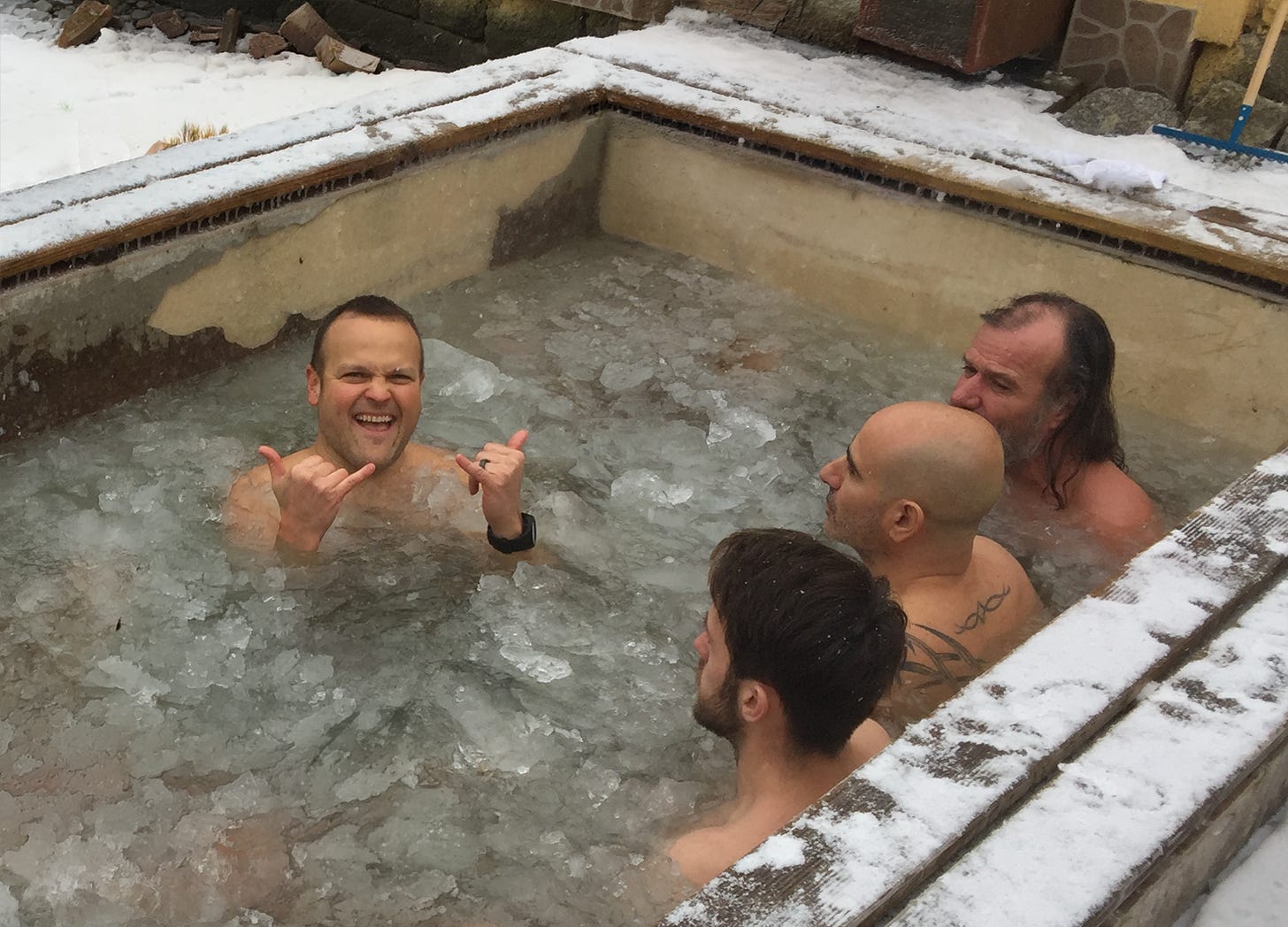
I was submerged to the collarbones in an ice bath in Poland, on camera, with Wim Hof three feet away, when an uncomfortable thought arrived.
Everything about the setup was correct. I knew the breathing protocol, understood the physiology, had adapted myself to cold, and had years of reading underneath all of it.
I could have narrated what was happening inside my body as it happened, using the right vocabulary and probably supplying the citations afterward. That is a real skill, and I am not going to diminish it because I eventually discovered its limit.
Sitting in that water, I realized that I had become extraordinarily good at overriding myself.
I had spent years calling that discipline.
The distinction has followed me ever since. I already understood the pattern intellectually; I could have explained its origin over dinner, traced the logic, predicted where it would appear next.
Yet none of that understanding had altered what I actually did. It took water cold enough that the part of me responsible for explaining everything had other work to do.
Wim was just a few feet away, and that detail matters to me. I was beside one of the world’s most persuasive teachers of breath, cold, and voluntary exposure to discomfort, practicing inside the method he had spent decades developing. He could correct my breathing, watch my physiology, and tell me when to get out.
He could not tell me which part of me had booked the trip.
Last Wednesday, writing about Penelope and Athena, I argued that the disappearance of an external guide may open a more demanding relationship with wisdom rather than close the account.
Poland gave me another version of the same lesson, approximately forty degrees less comfortable. The authority was present, competent, and generous, and he still could not perform the one act that mattered most.
I had to discover who was making my decisions.
That is the subject of this essay. The part of me capable of understanding a pattern was frequently absent when consequential decisions were actually being made. Those were different occupants of the same house, and only one of them had voting rights.
They do not ask permission
Archetypes are easily flattened into personality types, which makes them considerably less interesting. A personality type describes you; it can be scored, printed on a report, and discussed during a corporate retreat. An archetype describes a recurring form of human behavior or psychic organization. A psychologically healhty person can move through several of them in the same afternoon.
Jung’s claim went considerably further. Archetypes, in his model, arise from structures of the collective unconscious that precede individual biography, which means we encounter them rather than invent them. I hold that claim more cautiously than Jung did.
The systems version is easier for me to work with. Systems shaped by feedback, constraint, and history tend to develop recurrent configurations; once a particular response solves a problem reliably, the system becomes more likely to use it again, and reinforcement makes yesterday’s successful adaptation increasingly available tomorrow.
Human beings do this constantly. Under load we rarely survey the entire range of responses available to us, we reach for the configuration that has worked before, and success makes that effect stronger.
Look at one consequential decision you made at twenty-five and another you made last quarter. Ignore the subject matter for a moment and study the move. Did you push, withdraw, acquire more information, take responsibility before anyone asked you to, keep every option alive, protect somebody, or convert the uncertainty into another problem to solve?
A surprising amount of adult development consists of discovering that the decisions have changed while the underlying move has remained remarkably stable. Same move…better clothes.
That recurrence interests me far more than assigning someone a type. I have written here about treating the body as an instrument and about the danger that never forces a decision, and both arguments eventually reach the same boundary: you can improve every measurable input while leaving the governing question untouched.
The machine may be functioning beautifully, and that tells you very little about who has the controls.
Understanding is not custody
For years I treated understanding as a form of ownership. If I could name a pattern, trace its origin, anticipate its triggers, and explain its consequences, I assumed some part of me had therefore gained authority over it. That assumption was wrong because naming is not custody.
The mind that explains a decision afterward is not reliably the mind that made the decision when something meaningful was at stake.
Under pressure, highly rehearsed responses hold an enormous advantage: they have already been practiced, they require less deliberation, and they once solved something important enough to become part of the operating system. Conscious explanation often arrives later, and the explanation may be excellent.
That is one reason accomplished, psychologically sophisticated people can remain stuck for so long. Their interpretations keep improving. And, for the record, I’m not calling myself one of these…
The story becomes more coherent, more elegant, and better sourced, while the decision architecture remains almost untouched. Insight provides relief because confusion decreases, and relief is easily mistaken for transformation. I know that mistake intimately.
An old pattern also becomes easier to work with once I stop treating it as an enemy. I think of it more like an early employee who solved a serious problem, performed brilliantly, received repeated promotions, and eventually ended up running departments nobody ever hired them to manage.
The problem is not that they failed. They succeeded for too long. Sending a memo announcing that the company has changed accomplishes very little; what they need is repeated evidence that the environment is different, and experience inhabiting a role suited to the company that exists now.
The useful inquiry therefore becomes very specific. Who had the wheel, and what were they protecting?
Insight can explain the story of a decision without revealing who actually made it.
Whoever had the wheel has a name
Robert Moore and Douglas Gillette offered four names in King, Warrior, Magician, Lover. I change one. Where they use King, I use Sovereign, because the function interests me more than the gender or the throne.
The sovereign holds the capacity to hold a domain, establish order, recognize what deserves protection, and assume responsibility for what happens within it. The Warrior can act, defend a boundary, tolerate discomfort, and pay the cost of commitment. The Magician understands systems, acquires specialized knowledge, recognizes patterns, and knows how to intervene. The Lover allows attachment, desire, beauty, grief, pleasure, relationship, and genuine contact with something outside the self.
None is inherently mature. Each can become distorted when its particular capacity starts answering questions that belong to another function.
Sovereignty can decay into control, where the order of the domain becomes indistinguishable from the preferences of the person holding authority; its opposite distortion abandons responsibility and calls the retreat humility.
The Magician can use knowledge to manipulate, obscure, or remain permanently behind the curtain, and knowing how everything works becomes protection against ever having to declare what one wants.
The Lover can lose boundaries entirely, or can disappear, leaving numbness to masquerade as self-command.
The Warrior deserves special attention because its distortion rarely looks weak. It looks decisive. It can even look heroic.
Earlier this summer I wrote about the speech that killed Odysseus’ crew. Eurylochus is starving when he persuades the men to slaughter the sacred cattle of Helios. He is neither a coward nor a fool, and his speech has force precisely because it converts intolerable waiting into action. The courage is real. The situation required endurance. At full volume, the Warrior has an extraordinary ability to sound like the only adult in the room.
Moore and Gillette wrote for men within the mythopoetic men’s movement of the late twentieth century, and I see no reason to conceal that lineage or to pretend the framework emerged as contemporary psychological science. It did not.
What I find useful is the mechanism, and I have seen these functions in women as often as in men. I have certainly seen all four in myself.
There is one thing about the four I did not understand for a long time, and it changes what the model is for. They are usually presented as a set of capacities, four rooms of roughly equal size, with the developmental task described as balance. That framing hid the thing I needed to see.
The four are not peers. Three of them execute and one of them authorizes. The Warrior can act, the Magician can operate, the Lover can attach, and not one of those functions is designed to determine which of them the situation actually calls for. Deciding is sovereignty’s work.
Which means an unoccupied chair does not produce paralysis. It produces default rule. When nobody is governing, the most competent function governs, because that is what any system does with unassigned decision rights: authority migrates to whoever is already in motion. The function with the most evidence behind it is always the one already in motion.
This all brings me back to Poland. Cold immersion is close to a pure Warrior exercise. Sensation becomes intense, the organism says leave, and a conscious decision says stay. That was precisely why I was good at it.

It raises a question I still find uncomfortable, however: Had I traveled to Poland to develop something I lacked, or had I crossed an ocean to become even better at the strategy that had already carried me through most of my life?
The honest answer is that nobody asked. There was no deliberation I can point to, no moment where the options were laid out and the hardest one deliberately chosen. The Warrior had the wheel because the chair was empty, and I spent years calling the result discipline, because from the inside, override and authority are almost impossible to tell apart. Both of them feel like resolve.
We often choose developmental practices that flatter the part of us already strongest. The Warrior takes on a harder physical challenge; the Magician reads another book; the Sovereign accepts another position of responsibility; the Lover seeks another consuming experience. All four can spend years becoming more sophisticated while calling the process growth.
My realization in the ice was simpler. There are moments when greater mastery of your strongest function becomes a form of avoidance.
What you buried may be a strength
Shadow work is usually described as an encounter with what we find ugly, shameful, primitive, or unacceptable in ourselves. That territory exists and it deserves attention. Yet Jungian thought also gives us a more interesting possibility: human beings can disown admirable capacities.
What captivates us in another person, especially when the admiration carries an edge of irritation or envy, can point toward an unlived part of ourselves. This is commonly called the golden shadow.
For accomplished people I find this territory especially fertile, because success acts as a selection mechanism. Whatever configuration produced results receives reinforcement. You use it again, other people begin rewarding you for it, and eventually your identity grows around your most reliable adaptation. You become the person who can always push through, or the one who understands, or the one everybody can depend on, or the one who can make people feel alive.
The strategy works, and that is exactly why the competing capacities may remain underdeveloped. The person who repeatedly wins by pushing gets fewer opportunities to learn when waiting is the higher form of discipline. The person who wins through knowledge may never develop a mature relationship with uncertainty. The person who succeeds by carrying responsibility can become almost incapable of discovering what they want once nobody needs anything from them.
Nothing had to be repressed out of shame. Success crowded it out, which makes the missing capacity much harder to find, because there may be no wound marking the location.
It never hurt.
For someone entering the second half of life this creates a structural problem. The function that built the first chapter has the largest body of evidence behind it; you have spent decades proving that it works. It may also have less left to teach you than the capacities you never needed.
That is part of how accomplished people arrive at what I have called elegant stagnation: a life that continues functioning impressively while asking less and less development from the person living it.
You can remain there for years because nothing appears obviously wrong, and that is the trap.
The undeveloped function is not evidence that you failed to become a complete person. It may be unspent capital, and the next chapter may require precisely what the first one allowed you to neglect.
The strength that got you here has the largest body of evidence behind it. That does not mean it should govern what comes next.
What to do on a Tuesday morning
Psychological frameworks eventually have to survive Tuesday morning, and knowing which function dominated yesterday’s decision does not tell you what to do at nine tomorrow. This is where Angeles Arrien earns her place (yet again) in my own framework, and where I owe readers the argument I promised at the close of Wednesday’s essay.
Arrien was a cultural anthropologist who organized her work around four archetypal ways of engaging life: Warrior, Healer, Visionary, and Teacher. She associated each with a practice:
Show up and choose to be present. Pay attention to what has heart and meaning. Tell the truth without blame or judgment. Remain open to outcome rather than becoming attached to a particular one.
Her framework and Moore and Gillette’s sometimes get discussed as though they were alternate maps of the same territory. I do not think they are. Arrien gives me practices; Moore and Gillette give me functions through which behavior can be interpreted. Arrien asks what stance I can take now, while Moore and Gillette help me investigate what may already be organizing my behavior.
They share the word Warrior, and even there the resemblance is incomplete: Arrien’s Warrior concerns presence and the willingness to take a stand, while Moore and Gillette’s carries aggression, discipline, destruction, service, and their associated shadow forms. I treat them as related traditions rather than as interchangeable systems.
That distinction solves a practical problem. Moore and Gillette alone can leave you with sophisticated psychological language and no intervention; you become very good at describing who has been running your life. I have considerable experience with that particular accomplishment.
Arrien alone can become another set of admirable practices performed without enough attention to the psychic organization underneath them. You can practice presence while avoiding the truth, and you can become wonderfully unattached to outcomes you were frightened to pursue in the first place.
The frameworks become more useful when they constrain one another. Diagnosis without practice is the insight trap, which is the subject of this entire essay. Practice without diagnosis is a morning routine.
Where the frameworks fail
I trust a framework more when I know where it stops working.
Jung gives us a generative way of seeing recurring psychic forms and no clean method for falsifying any particular reading of them. Moore and Gillette offer a memorable architecture with none of the psychometric foundation I would want before calling it measurement.
Arrien claimed more across traditional cultures than most contemporary anthropologists would, and I find her practices more durable than her scaffolding. Systems thinking explains how a person reinforces configurations over decades, and it cannot tell me which part of me is protecting an old identity on a particular Wednesday.
So I use them as lenses rather than findings. Each turns dangerous at the same point, where metaphor hardens into ontology and the map begins demanding that the person conform to it. They correct each other, and the correction is usually where the useful information appears.
Run the last five
Here is the exercise I would actually do. I call it The Last Five, and it takes about thirty minutes.
Take the last five consequential decisions you made. I mean the last five, chronologically; avoid curating the impressive ones. A consequential decision is one in which somebody’s time, trust, money, relationship, opportunity, or future moved because of what you decided.
For each decision, write down what you believe you were protecting. Protection is different from the stated objective. The objective may have been growth, efficiency, loyalty, prudence, opportunity, family, strategy, or principle, so go underneath it. Were you protecting solvency, standing, freedom, someone’s opinion of you, your identity as the competent person, your ability to avoid disappointing somebody, the belief that you still have unlimited options, or the right to continue telling a particular story about yourself?
Then run two different tests on those answers, because they find two different things. Look across the five and ask which response appears most often, which tells you which function holds seniority. Then notice which of the five answers arrived fastest, which tells you which function is automatic. Seniority and automaticity are not the same finding, and the fast one is what this essay is about.
Pay particular attention to the decision you described to yourself as courageous. Ask whether it required a capacity you had not already spent decades developing. That question has become important to me.
Courage exercised through your strongest function can be remarkably inexpensive, and a Warrior volunteering for another battle may experience almost no developmental risk at all.
Now look for the missing function. Across five consequential decisions, where is the capacity that never appears? Where is the Lover in a life run almost entirely by Magician and Warrior? Where is sovereignty in the person who has spent thirty years being indispensable to everyone else’s agenda? Where is the Magician in the leader whose preferred answer to uncertainty is greater force?
Absence does not prove you have found a golden shadow. It gives you somewhere worth looking.
There is one final step: take one of the five decisions to somebody who was actually there, tell them what you now believe you were protecting, and ask them what they saw. Do not defend your interpretation. Listen.
You will probably discover that at least one decision does not look, from the outside, the way it has been organized in your own memory. That correction matters because introspection carries a structural limitation: the same system conducting the investigation is the system under investigation.
We need other people, we need consequences, and sometimes we need an ice bath in Poland.
I spent much of the first half of my life developing the ability to endure, solve, push, understand, and keep moving when conditions became difficult. Those capacities have served me extraordinarily well, and I have no interest in amputating them in the name of growth. The work now is more demanding. They need to become capacities I can choose rather than authorities I automatically obey.
That is the difference I missed for years. Maturity, to me now, is knowing who took the wheel, why they reached for it, and whether anyone ever actually handed it to them.
And if you are willing to write back one line, make it this: which of the four has been running your last five decisions, and is it the one those decisions needed? Replies reach me directly. I read every one, and they shape what I build here next.
Next Sunday: Everest, and the difference between the part of you that wants the summit and the part of you the summit is for. What happens to a person when the thing they organized a decade around is finally behind them, and why the descent is where the real accounting starts.
Start here
Every essay in this publication builds on the five that launched it. If you are new, they are the place to begin.